Government has announced a bold five-point intervention to end the exclusion of persons with dwarfism from national development planning, admitting they have for long been invisible in data, budgets and infrastructure design.
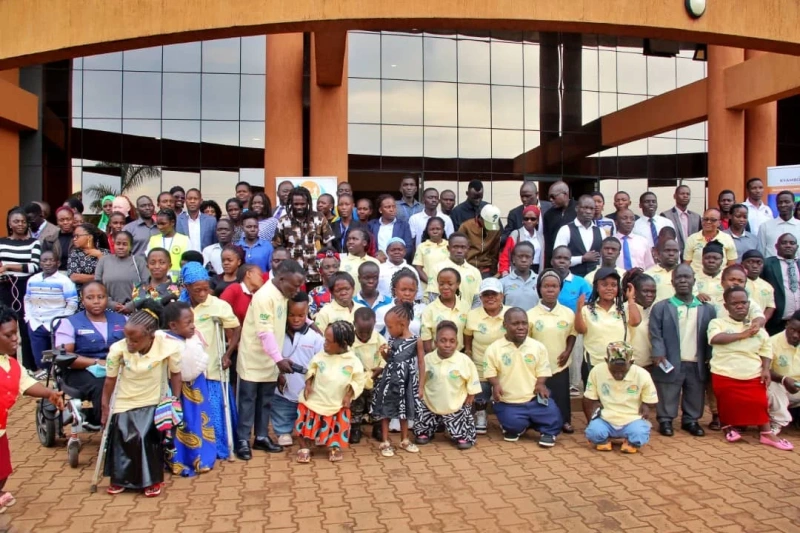
The commitments were made at Kyambogo University during the commemoration of the International Day for Persons Affected by Dwarfism, held under the theme _"Advocacy for Inclusion of Dwarfism in Development Planning."_
The Minister of State for Disability Affairs, Hon. Acan Joyce Okeny, in a speech delivered on her behalf by her Personal Assistant Mr. Sarich Andrew, said government can no longer plan around four disability categories while leaving little people behind.
In a strong call for inclusion, the Minister emphasized that inclusion must start with being counted. She pledged that the Ministry will engage the Uganda Bureau of Statistics (UBOS) and NUDIPU to ensure persons with dwarfism are explicitly captured in the next National Disability Survey and Labour Force Survey, arguing that if you are not in the data, you are not in the budget.
On education, the Ministry committed to work with the Ministry of Education and Sports and Kyambogo University to issue a circular on reasonable accommodation for learners with dwarfism. This will include provision of adjustable desks, lab stools, accessible toilets and a strict anti-bullying policy in schools. To build professional support, government will also support five more scholarships for special needs teachers specializing in dwarfism care.
Addressing health concerns, Hon. Acan noted the unique medical challenges faced by persons with dwarfism, including orthopedic and spinal complications and stigma in maternal health care. She pledged to open dialogue with the Ministry of Health to develop clinical guidelines for managing achondroplasia and other forms of dwarfism, and to establish a respectful maternal health protocol for women with dwarfism.
On livelihood and economic empowerment, the Minister announced that government will ring-fence at least five percent of the Special Grant for Persons with Disabilities specifically for organizations of little people.
The Ministry will also advocate for their inclusion in Parish Development Model Enterprise Groups to address high unemployment driven by discrimination where employers judge height, not skill.
Finally, to fix inaccessible infrastructure, the Minister pledged that through the National Council for Disability, government will review the national accessibility audit tool to include height-related standards, such as low-reach counters, footrests and adjustable furniture in schools, hospitals, banks and public offices. She stressed that accessibility is not only about wheelchairs.
The Minister clarified that dwarfism, with over 200 medical types, is not a curse, not contagious and not a failure, but a medical condition. She celebrated little people in Uganda who are serving as doctors, teachers, lawyers, artists and parents, and warned that stigma continues to cause school dropouts, especially among girls with dwarfism.
Mr. Sarich reiterated the Ministry's ongoing support which includes registration and empowerment of the Little People Association of Uganda, inclusion of persons with dwarfism in the National Council for Disability, and livelihood grants.
Kyambogo University was commended for hosting the event, being recognized as the home of Special Needs Education in Uganda.