
By Mutuunzi Saul
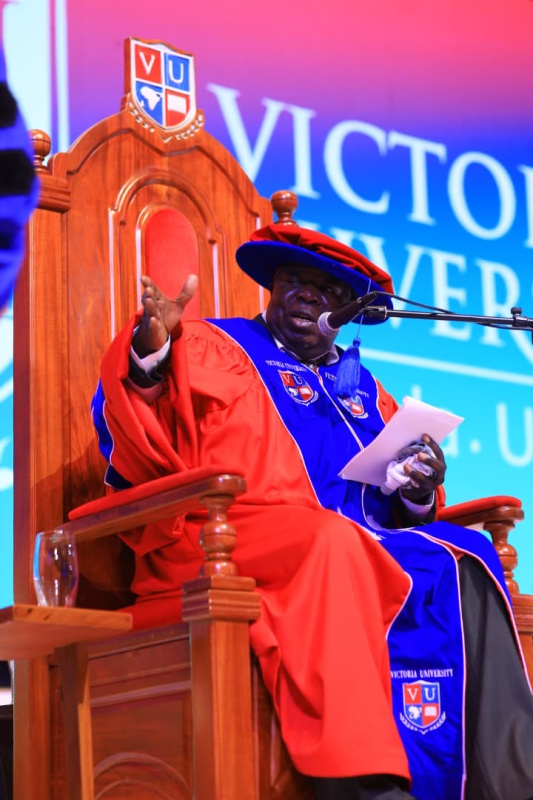
Victoria University Chancellor Prof. John Opuda-Asibo has called on universities across Uganda to integrate Artificial Intelligence (AI) into all academic programmes, warning that institutions must continuously adapt their curricula to keep pace with rapidly changing technologies and emerging fields of study.
Speaking at the university’s 10th graduation ceremony held at Speke Resort Munyonyo, Prof. Opuda-Asibo said higher education institutions needed to embrace continuous curriculum reviews to equip graduates with relevant knowledge and skills for the changing world.
He noted that new fields of study were emerging every day, requiring universities to rethink how they prepare students for the job market and the demands of modern society.
The Chancellor highlighted the importance of statistics in several disciplines, including actuarial science, transport and insurance, biosciences such as medicine, public health, pharmacy, agriculture and biotechnology, as well as physical sciences covering physics, automation, geology and climate computation.
He challenged universities to clearly define the levels of Artificial Intelligence they teach, noting that AI encompasses both basic and advanced applications that require appropriate academic preparation.
Prof. Opuda-Asibo further urged institutions to incorporate the study of AI into their curricula, including its benefits, limitations and ethical implications, to ensure graduates understand both its opportunities and potential risks.
RELATED
Addressing the graduates, he encouraged them to protect and value their education, describing knowledge as a source of independence, competitiveness and the ability to understand and navigate their environment.
He urged them to develop a culture of critical thinking, continuous learning and personal responsibility, emphasising the importance of questioning information, reviewing their knowledge and taking responsibility for what they say and write.
Supporting the Chancellor’s call, Victoria University Vice Chancellor Dr. Lawrence Muganga warned that Uganda risks falling behind in the global Artificial Intelligence revolution unless deliberate measures are taken to prepare learners for the emerging digital economy.
Dr. Muganga called on the government to introduce a nationwide One Laptop Per Child policy, proposing that every learner from Primary Five through university, including students in Technical and Vocational Education and Training (TVET) institutions, should be equipped with a laptop.
He argued that access to digital devices and AI-driven learning would be essential if Uganda is to achieve its Tenfold Growth Strategy target of building a $500 billion economy by 2040.
According to Dr. Muganga, Artificial Intelligence is already transforming education, business and employment, making digital preparedness an urgent priority for the country.
He compared the AI revolution to an iceberg that had already struck Uganda’s and Africa’s ship, warning that the continent must respond decisively to avoid being left behind by technological advancements.
To address barriers to digital access, he proposed the use of solar-powered laptops and satellite internet connectivity, particularly in underserved communities where access to electricity and reliable internet remains a challenge.
Dr. Muganga said the proposed initiative was achievable if the government made the necessary policy decisions and committed resources to expanding access to technology in education.
He also revealed that Victoria University had integrated AI across all its academic programmes, saying the approach was intended to prepare students not merely to pass examinations but also to live, work and thrive in an increasingly technology-driven world.

On the university’s growth, Dr. Muganga said student enrolment had increased from 180 in 2020 to 16,000 currently, while the number of graduates had risen from 48 in 2021 to 2,600 this year.
He attributed the growth to the institution’s development and expansion of its academic programmes, adding that further investment in infrastructure was planned to support its ambitions.
Dr. Muganga announced that construction of a new Victoria University campus in Naguru, which will include a teaching hospital to support the institution’s new medical school, is scheduled to begin in January 2027.
The proposed development is expected to expand the university’s training capacity in medical education and provide facilities to support practical learning.
The calls by the Chancellor and Vice Chancellor place Artificial Intelligence, digital access and curriculum reform at the centre of discussions about the future of higher education in Uganda, as universities seek to prepare graduates for changing workplace demands and emerging technologies.